

































Plan production from stock counts that match the shelf.
When the shop floor and the back office work from different numbers, schedules slip and the margin figures get disputed. We connect production, inventory and finance on Dynamics 365 or Odoo, so the schedule, the costing and the order book agree.
Free, 30 minutes, with a senior consultant. You leave with a recommended first phase or a clear reason to wait.

Where the plant and the office disagree.
Schedule in a workbook
The schedule sits with one planner and a fragile workbook, so one absence can stall the line.
Phantom inventory
On-hand counts drift from the shelf. You over-buy raw materials and still run short.
Stale standard costs
Overhead is allocated by gut feel, so the real margin per SKU is unknown.
Quality records in binders
Non-conformance, CAPA and traceability records sit in paper files and email.
ERP for the whole plant.
BOMs, routings, MRP and costing run on one platform, and every move on the floor posts to the ledger. That covers multi-level BOMs, work-center capacity, lot and serial traceability from receipt to shipment, and actual costing that ties out to the general ledger.
CRM that promises dates the plant can meet.
Quote-to-cash for engineered products, plus field and warranty service. Sales configures and prices made-to-order products, promises dates from the capacity schedule and shares one account record with the ERP.
What goes live on the floor first
Finite scheduling
A capacity-aware schedule that adjusts to live machine status.
Real-time WIP
Operators clock jobs at the station, and scrap and yield update as work happens.
Lot traceability
Genealogy from raw lot to finished serial, so you can scope a recall from system records in place of paper files.
Margin by SKU
Actual cost rolled up per product, so pricing and product-mix decisions use real numbers.
Modules for plants on each platform
 Microsoft Dynamics 365
Supply Chain Management
Production control, MRP and costing for larger plants.
Business Central
Light manufacturing for smaller shops.
Field Service
Warranty, spare parts and on-site service.
Power BI
Power BI dashboards for OEE, scrap and margin, built on one agreed definition per metric.

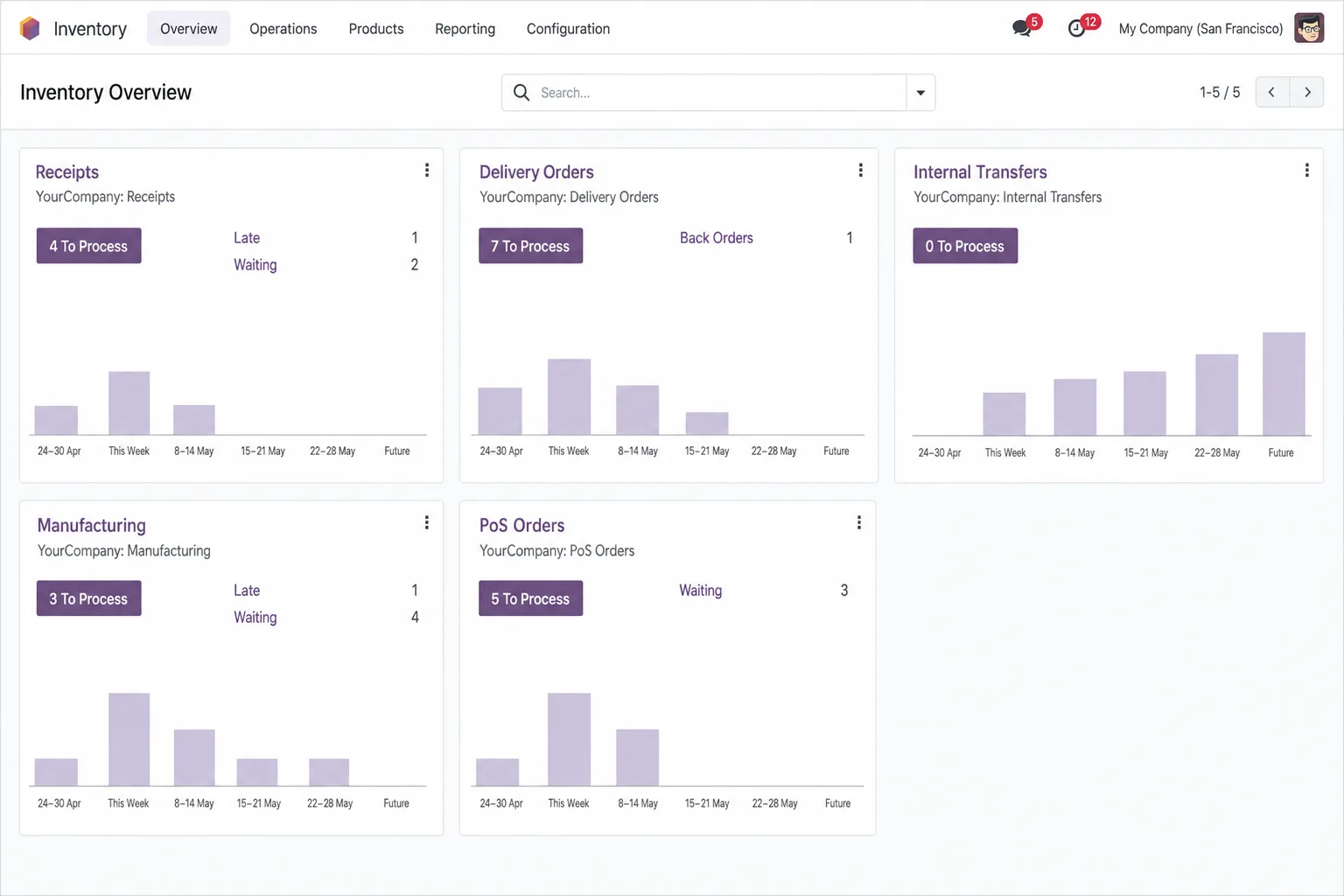
Manufacturing (MRP)
BOMs, work orders and shop-floor execution.
Inventory
Lot and serial traceability.
Quality & Maintenance
In-line quality checks and preventive maintenance.
Accounting
Cost accounting linked to production.
From one cell to the whole plant
Discovery starts on your shop floor with a senior consultant, and every phase after it runs through the five delivery stages. In a plant, the first phase usually looks like this:
- 01
Walk the floor and map the flow
We trace one product from purchase order to shipping dock, and we hand you process maps and a written scope for the first phase.
- 02
Design the production model
We build BOMs, routings, costing rules and the schedule on your real items and demand.
- 03
Pilot one cell, then expand
One line goes live with its operators first while the rest of the plant keeps producing.
- 04
Stabilize against live OEE
Through launch stabilization we tune the schedule, costing and leadership dashboards.
Questions buyers ask
Will the rollout stop the line?
It shouldn't. We pilot one cell, rehearse the cutover in a sandbox and scale cell by cell in planned windows.
Do you handle process and discrete manufacturing?
Yes, both. On Dynamics 365 Supply Chain Management, process plants get recipes, batches and yield. On Odoo and Business Central, process recipes need configuration or an add-on. Discrete plants get BOMs, routings and serials on every platform. If you run construction or civil engineering projects, our fixed-scope Odoo packages for those industries may fit better.
Can it talk to our machines and MES?
Yes. We connect shop-floor data capture, PLCs and your MES through supported connectors and APIs, so data is entered once.
How long until the first cell is live?
After a free discovery call, the written proposal sets the timeline for your first phase.
What decides the price of the first phase?
The price follows the scope: plants, work centers, users and integrations. Each phase gets a fixed price in the written proposal before it starts, and our ERP implementation cost guide lists typical ranges.