









 Microsoft Dynamics 365
For teams on Microsoft 365 that need multi-entity finance, stricter controls or Power BI reporting.
Explore Dynamics 365 solutions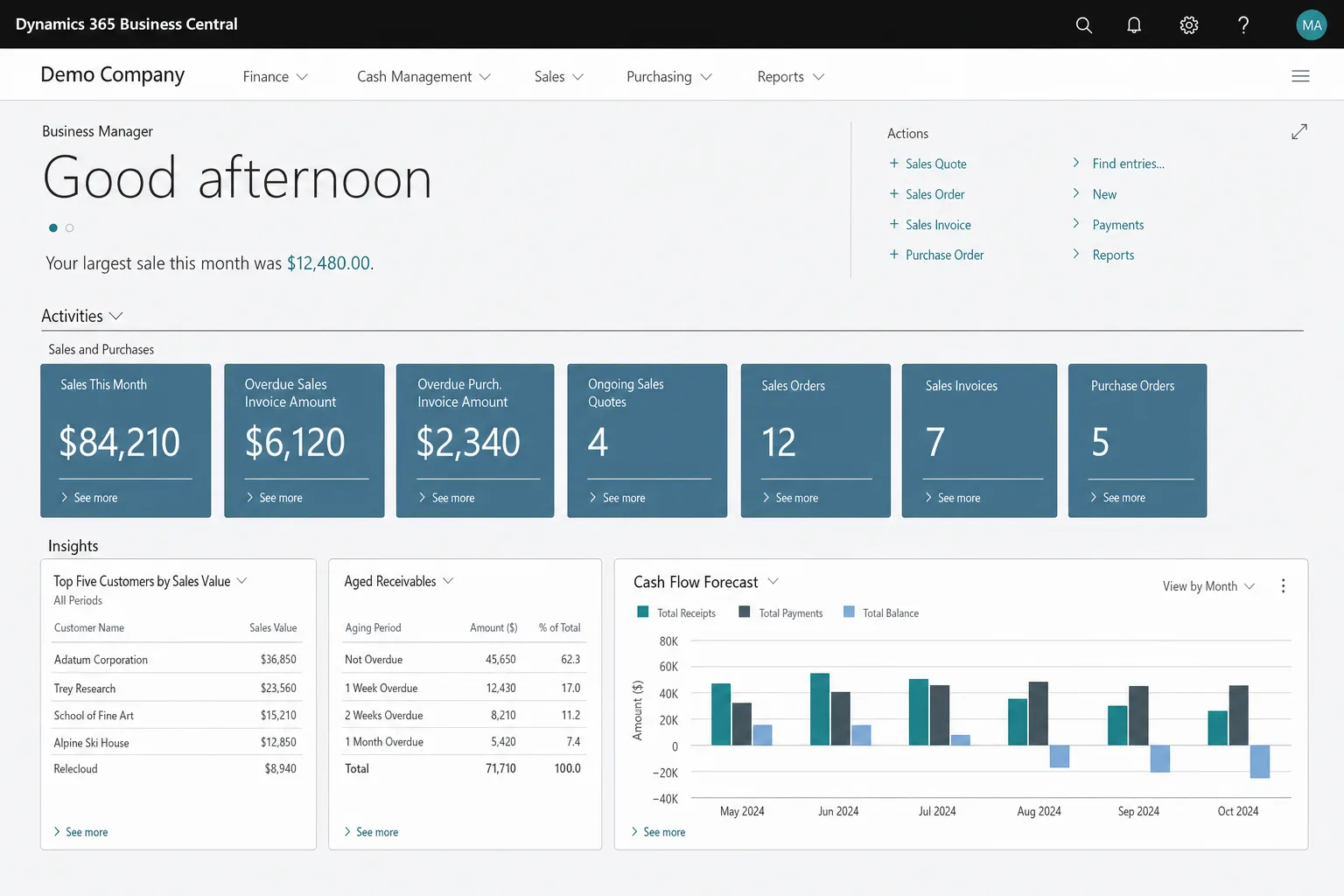 Microsoft Dynamics 365Business Central, Sales, Field Service, HR and Copilot
 Dynamics 365 SalesPipeline, forecasting and quote-to-order
 Business CentralFinance, inventory, projects and cash flow
 Field ServiceWork orders, scheduling and SLAs
 Human ResourcesEmployees, leave and compensation
 Microsoft CopilotCopilot across Microsoft 365, with permissions fixed first
 OdooSales, Finance, Services, HR, Supply Chain and MarketingOdoo SalesQuotes, signatures, payments and subscriptions
 Odoo FinanceInvoicing, bank reconciliation and expenses
 Odoo ServicesProjects, timesheets and field serviceOdoo Human ResourcesEmployees, contracts, leave and recruitment
 Odoo Supply ChainInventory, purchasing and manufacturing
 Odoo MarketingEmail, SMS, social and events
 All industriesEvery vertical we serve
 ManufacturingScheduling, traceability and costing
 Wholesale and distributionPricing, sourcing and fill rate
 Retail and e-commerceOne stock pool across channels
 Logistics and supply chainVisibility, 3PL billing and cost-to-serve
 Professional servicesUtilization, WIP and billing
 Odoo industry packagesCore and Growth packages by industry
 ConstructionTender to handover for contractors
 Civil engineeringDesign, site visits and project costs
 Engineering servicesWork packages, capacity and billing
 Architecture and planningDesign phases, fees and studio capacity
 Accounting firmsRecurring engagements and client service
 Guides264 guides on ERP and CRM decisions
 Choosing your ERPThe guides to read before you pick a platform
 What ERP costsLicenses, implementation and running costs
 BlogField notes on Odoo and Dynamics 365
 ToolsCalculators and a comparison matrix on published pricesOdoo pricing calculatorPlan, users, hosting and a three-year total
 D365 license calculatorBusiness Central, Finance, Sales and Service at list price
 ERP comparison matrixSix platforms on price, fit and time to implement
 ERP ROI calculatorThe yearly cost of manual work, and the payback
ERP and CRM implementation for growing businesses. We set up Microsoft Dynamics 365 or Odoo in phases, starting with the workflows that cost you the most, and stay through launch stabilization.
Free, 30 minutes, with a senior consultant. You leave with a recommended first phase or a clear reason to wait.

Odoo
Order to cash
Migrate and connect3 of 5
Open customer records moved0/ 4,200
−30%
target for manual order entry
Implementation, customization and integration on Microsoft Dynamics 365 and Odoo.
We recommend the one that fits your budget, workflows, integrations and growth plan, and show you why.
Microsoft Dynamics 365For teams on Microsoft 365 that need multi-entity finance, stricter controls or Power BI reporting.
Explore Dynamics 365 solutions
For SMEs that want to start with a few apps at a lower cost and add modules as they grow.
Explore Odoo solutions
Not sure yet? Compare Odoo and Dynamics 365
Construction, engineering, architecture or accounting firm? See the Odoo industry packages
Finance, operations and inventory configured around your structure, roles and approval flows. Every gap between standard ERP and your real process gets a decision before anyone builds.
Explore ERP implementationPipeline, service cases and customer history on one record, with written rules for when a deal moves stage, so the forecast holds up in the board meeting.
Explore CRM implementationYour ERP, CRM, store and payment tools share one set of data. We define who owns each record and what happens when a sync fails.
Explore system integration| Process | Standard fit | Gap | Decision |
|---|---|---|---|
| Order to cash | Fits | None | Configure |
| Landed cost | Partial | Freight split by weight | Extend |
| Sales approvals | Partial | Three approval limits | Workflow |
| Intercompany | Fits | None | Configure |
| Legacy price lists | No | 1,900 custom rules | Simplify first |
| Stage | A deal enters when | Owner |
|---|---|---|
| Qualified | Budget and decision-maker confirmed | Sales rep |
| Scoped | First phase agreed in writing | Sales rep |
| Proposal | Price and timeline sent | Sales lead |
| Committed | Signed, handed to delivery | Sales lead |
| From | To | What | How often |
|---|---|---|---|
| {shopify} Shopify | {odoo} Odoo Sales | Orders and refunds | Every 5 min |
| {stripe} Stripe | {odoo} Finance | Payouts and fees | Daily |
| {dhl} Carrier API | {odoo} Inventory | Tracking and delivery | On event |
| Payroll | {odoo} General ledger | Journal entries | Monthly |
Five stages, in the same order on every project. On the Odoo industry packages, the package sets the allowances and the length, from 8 weeks for an accounting firm on Core to 28 weeks for a contractor on Growth.
We map your processes, legal entities, data sources and connectors, then write the scope.
You sign the scope
We set up the package apps and adapt fields, forms, approvals and reports within your customization hours.
You review progress weekly
We load master data and open transactions from the templates you supply, and connect your named connectors.
You approve the mapping
Your team runs user acceptance testing, we retest every defect, and your champions train in 2-hour sessions.
You sign off UAT
We rehearse the cutover, go live, then stay through launch stabilization with advisory hours.
You sign off stabilization
| Allowance | Core | Growth |
|---|---|---|
 Project management | 30 minweekly status meeting with a dedicated manager | 1 hweekly status meeting, plus a fortnightly steering review |
 Customization | 32 hof customization at most (48 h for construction) | 64 hof customization at most (96 h for construction) |
 Data migration | 1source system, up to 8 data objects | 3source systems at most |
 Integrations | 1named standard connector | 3named standard connectors at most |
 Testing and launch | 1UAT cycle, defect retest, cutover rehearsal and one go-live | 2UAT cycles, cross-company and integration tests, up to 2 rollout waves |
 Training | 6two-hour sessions for up to 8 champions, with recordings and guides | 6sessions for up to 8 champions (construction Growth: 8 sessions for up to 12 champions) |
 Launch stabilization | 30business days, up to 10 advisory hours | 45business days, up to 22 advisory hours |
They translated strategy into executable milestones and kept every decision tied to measurable ROI.
If people each lose hours a week re-keying data and chasing approvals, at $ an hour, manual work costs you a year.
At our target of a 30% cut in this manual work, that frees a year. With a first phase of $k, payback takes about months.
An estimate, not a quote. Assumes 48 working weeks and the 30% manual-effort target.
Faster delivery. Designed to deliver up to 3x faster than a traditional implementation, using reusable templates and testing in every phase.
Named senior consultant. The person who scopes your project leads it through launch stabilization.
Less manual effort in the workflows we automate and integrate, measured against the baseline we agree in discovery.
| Question | Flectic | Large systems integrator | Independent freelancer | In-house build |
|---|---|---|---|---|
| Time to value | A first usable phase, then the next | Often a multi-phase program | Depends on their availability | Competes with the internal backlog |
| How you pay | Fixed price per phase | Time and materials | Hourly | Salaries and opportunity cost |
| Who does the work | A named senior consultant, supported by a dedicated project manager | A delivery team assigned after signing | One person | Staff alongside their day jobs |
| After go-live | Launch stabilization with the consultant who built it | Often a separate support contract | Agreed case by case | Your team owns it |
| Accountability | One named delivery owner | Account and delivery teams | The freelancer alone | Shared across departments |
We scope in phases and start with the workflows that cost you the most. You pay a fixed price for a first release that works, then decide on the next phase. The ERP implementation cost guide lists typical ranges by company size.
They slip when requirements, testing and training are left to the end. Discovery takes one to two weeks and ends with a written scope. We test in every phase and train people before go-live.
We roll out in controlled phases with user acceptance testing, training and launch stabilization, so daily work keeps running while the new system comes in.
We implement both and earn no vendor quota on either. We recommend the one that fits your budget, workflows, integrations and growth plan, and we explain why.
Only for steps agreed in your scope, such as drafting test scenarios, and a consultant checks each output. Your data stays under the handling rules in your contract.
Every engagement has a written scope, change control, documentation and training, then launch stabilization with the consultant who built it. One named owner stays accountable throughout.