






































Business Central consultants who close the month on one ledger
Flectic implements Dynamics 365 Business Central for companies of 20 to 100 people in the US and Canada that have outgrown QuickBooks, Sage or Dynamics NAV. Finance goes live first, then inventory, projects and cash flow, in phases you approve one at a time, and we work alongside your team through the first month-end close.
Free, 30 minutes, with a senior consultant. You leave with a recommended first phase or a clear reason to wait.

Signs finance has outgrown its ledger
The close takes longer each quarter, and leadership waits for numbers it then questions.
Month-end drags and the numbers get disputed
Manual journals, side spreadsheets and separate AP and AR files make reconciliation slow, and by sign-off the numbers are already stale.
Cash is a guess until the statement lands
Without daily bank reconciliation and a cash-flow forecast, a shortfall shows up when a payment bounces. Late fees, lost early-payment discounts and emergency borrowing follow.
Stock values and job costs drift
Stock values drift, project WIP stays unknown until invoicing, and manufacturing margins are rebuilt by hand each quarter.
The last ERP attempt stalled
A big-bang rollout overruns and gets shelved, and you keep paying for the problem it was meant to fix.
What we configure in Business Central
General ledger
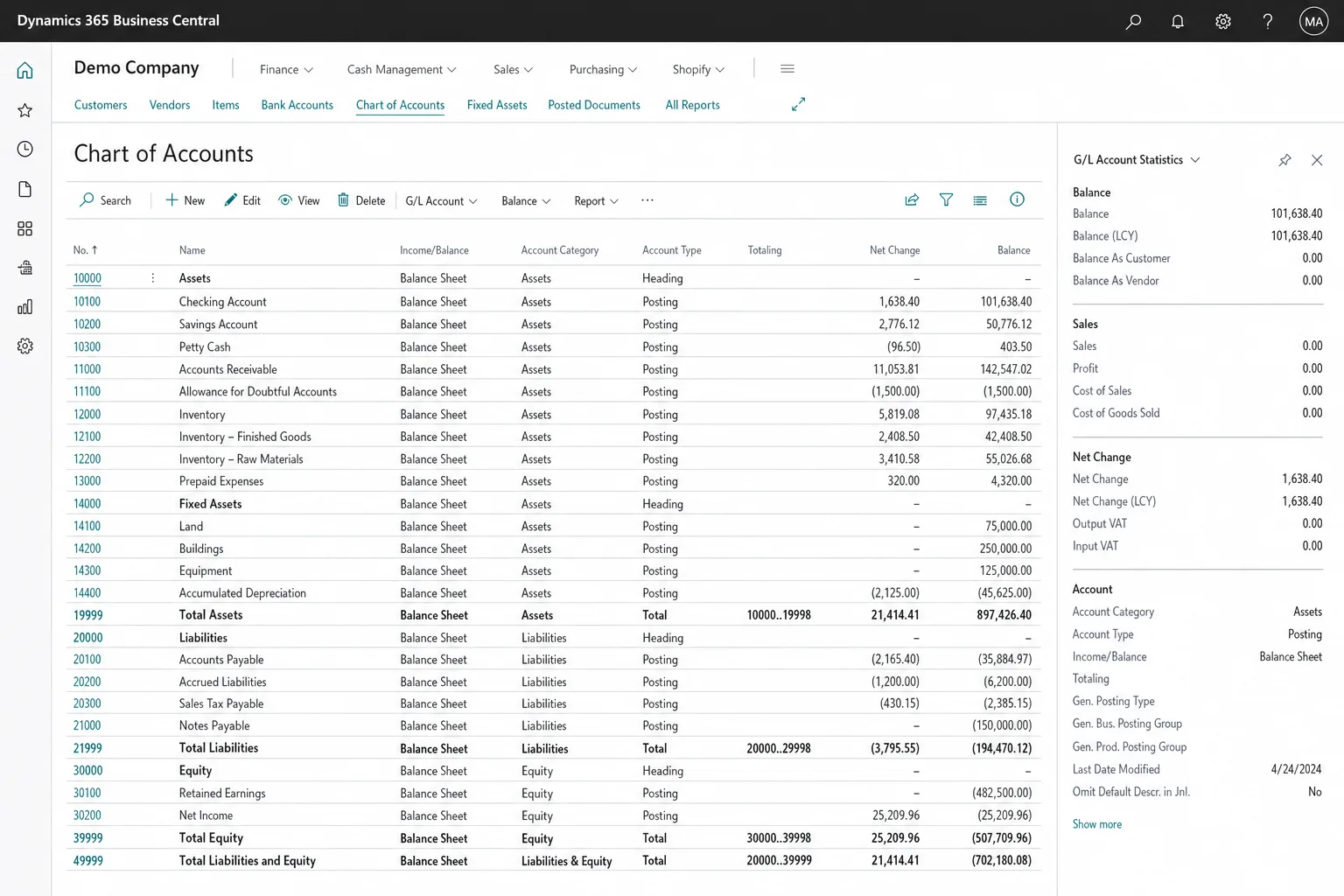
Every transaction posts to one ledger with dimensions, so every report draws on the same figures.
Accounts payable and receivable
Supplier bills and customer invoices post straight to the ledger, so aging reports stay current.
Bank reconciliation assistance
Copilot proposes matches between statement lines and entries. Your finance team confirms each one, so the books stay current.
Cash flow management
Forecasts built from open receivables, payables and orders, so you see a shortfall coming before it lands.
Budgeting
Set budgets by dimension and compare actuals as transactions post.
Service management (Premium license)
Service contracts, items and orders post to the same financials as the rest of the business.
Payables Agent
Reads vendor invoices from a shared mailbox, drafts the purchase invoice and sends it to a person for approval before it posts.
Expense Agent
Reads receipts, categorizes expenses and files the claim. A reviewer approves each one.
Finance first, then operations
You run each release on your own numbers before the next one starts. The ledger goes first because every later release posts to it, and each release runs through the five stages of the Flectic Accelerated Delivery Framework.
- 01
Discovery and fit assessment
We map your chart of accounts, close process, inventory and reporting against Business Central. You also get a fit verdict and a phasing decision.
- 02
Finance foundation
We set up the GL, AP, AR, dimensions and bank reconciliation, then migrate and reconcile opening balances. The first release goes live on your own numbers.
- 03
Operations and costing
We configure inventory, manufacturing (Premium license) or projects and jobs, including landed costs, WIP and routings, so daily activity posts correctly.
- 04
Agents and automation
We switch on the payables and expense agents with approval steps and build Power Automate flows for routine tasks. A person reviews every entry before it posts.
- 05
Reporting and cash visibility, then launch stabilization and handover
Power BI dashboards, the cash-flow forecast and management reports, each built around a decision leadership makes. Then we work alongside your team through the first month-end close on the new system, fix issues and document the configuration. Your team then runs Business Central on its own.
Who our Business Central implementation fits
If more of the right-hand column describes you, another kind of firm will suit you better.
Flectic fits when
Entry-level accounting no longer closes the month
You run QuickBooks, Sage or Dynamics NAV today, and the close depends on side spreadsheets and manual journals.
You have 20 to 100 people and work in Microsoft 365
Quotes leave from Outlook, approvals happen in Teams and leadership reads Power BI.
You want finance proven before operations
The finance foundation goes live first, and you decide on inventory, projects and agents after it has run a close.
Look elsewhere when
Your shortlist requires Microsoft certifications
Flectic holds no certification from Microsoft, so a tender that scores vendor designations will rank us low.
You run a multi-country group with complex manufacturing
Dynamics 365 Finance and Operations may fit better than Business Central. Discovery shows which side of that line you are on.
You want an adviser who never implements
Flectic recommends a platform and then implements it. A selection-only adviser suits buyers who want those two jobs done by different firms.
For businesses past entry-level accounting

Jobs track labour, materials and subcontract costs against budget with work in progress, so margin shows while the work is still running.
Connected to the rest of your systems




Microsoft 365
Quotes leave from Outlook, price lists open in Excel and approvals happen in Teams.

Reporting
Finance and stock figures refresh into Power BI without exports.


CRM
Customers and orders stay in step with your CRM.


Commerce
Web orders come in as sales orders and stock levels go back to the store.


Payments
Card payments land against the right invoice.
Banking
Bank feeds arrive every morning, ready to reconcile.
How we avoid the usual causes of ERP failure
One consultant owns your chart of accounts
The senior consultant who maps your close in discovery designs the dimensions, reconciles the opening balances and sits with your team through the first close on the new system. A dedicated project manager runs the plan around them.
Releases you judge before you commit
Each release works on its own. If the first one does not earn your confidence, you stop there with a working finance system.
Fixed scope and a clean handover
Each phase has defined deliverables and documented configuration. Scope changes go through agreed change control.
What Business Central costs and where it starts
Microsoft licenses are billed separately from Flectic's work. The Business Central license calculator works out a monthly and yearly figure for your user mix.
Free discovery call
A 30-minute call with a senior consultant about your close, inventory valuation and reporting. A written proposal follows with a phased plan and a fixed price for the finance foundation.
Finance foundation go-live
General ledger, payables and receivables, dimensions, bank reconciliation and reconciled opening balances, live in production. You decide on operations and agents after you have seen it run a close.
Full program
Operations, costing, Copilot agents and reporting, each scoped as its own release, so you control the pace and the spend. Anything you want after launch stabilization is scoped as a new phase.
Business Central licenses
Microsoft 2026 list price, not a Flectic price: Essentials is $80 per user a month, Premium is $110 and Team Members is $8.
Copilot and agents
Copilot features such as bank reconciliation matching come with the license. Agents that work on their own, such as the Payables Agent, use Copilot Credits billed by consumption.
Questions buyers ask
What does a Business Central consultant do?
A Business Central consultant maps your chart of accounts, close and inventory to Business Central, configures it, migrates and reconciles your opening balances, trains your team and supports the first close. At Flectic the senior consultant who maps your close in discovery stays through launch stabilization.
How long does a Business Central implementation take?
The written scope sets the timeline for each release. As a market range, a standard mid-market Business Central project runs 3 to 9 months. The finance foundation goes live first, so you work on your own numbers before the full program ends.
Is Business Central enough, or do we need Finance and Operations?
For most growing companies, Business Central is enough. It covers finance, sales, purchasing, inventory, projects and light manufacturing. Finance and Operations fits multi-country groups with complex manufacturing or warehousing, and discovery shows which side of that line you are on.
What does Business Central cost per user?
After Microsoft's November 2025 price update, list prices are $80 per user per month for Essentials, $110 for Premium and $8 for Team Members. Implementation is priced separately, phase by phase. The license calculator works out a monthly and yearly figure for your user mix.
Can we move from Dynamics NAV, QuickBooks or Sage?
Yes. We migrate master data, open transactions and opening balances, and reconcile them before go-live. Older history stays in reports or a read-only archive when moving it would cost more than it saves.
Do we pay extra for Copilot in Business Central?
Copilot features such as bank reconciliation matching come with the Business Central license. Agents that work on their own, such as the Payables Agent, use Copilot Credits, billed by consumption, so we agree with you which agents to switch on and where a person approves their work.
How do I choose a Business Central partner?
Separate the jobs first: the reseller that holds your subscription, the firm that builds the system and any independent adviser. Then compare named consultants, references at your size, a written phase scope and the terms for ending delegated access. Microsoft sells Business Central only through its partner network, so the license price comes from a reseller, and the services price comes from whoever builds.
Book a Business Central discovery call
Free, 30 minutes, with a senior consultant. We look at your ledger, inventory and reporting needs and tell you where a first phase should start. You leave with a recommended first phase or a clear reason to wait.
Related reading on the blog
- Business Central consultant rates and what a first phase costs
- Choosing a Business Central partner in Ontario and Toronto
- How to choose a Business Central implementation partner: quotes, contracts and red flags
- Business Central as accounting software: cost and fit
More on the blog: Choosing an ERP or CRM